South African Border War
Asymmetric conflict between SADF and PLAN, ending with Namibian independence.

Aeroprints.com · CC BY-SA 3.0
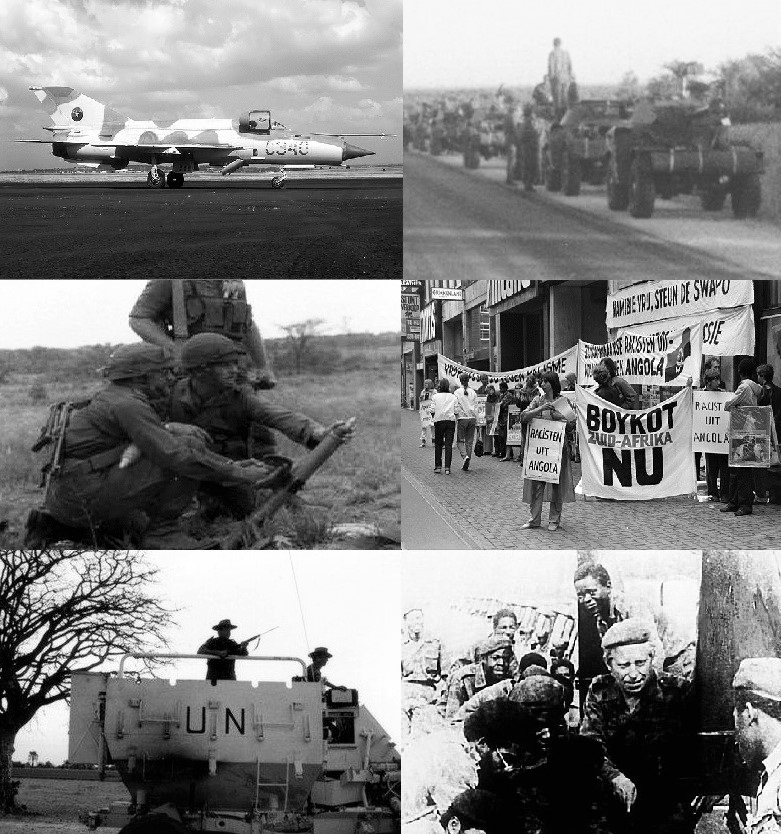
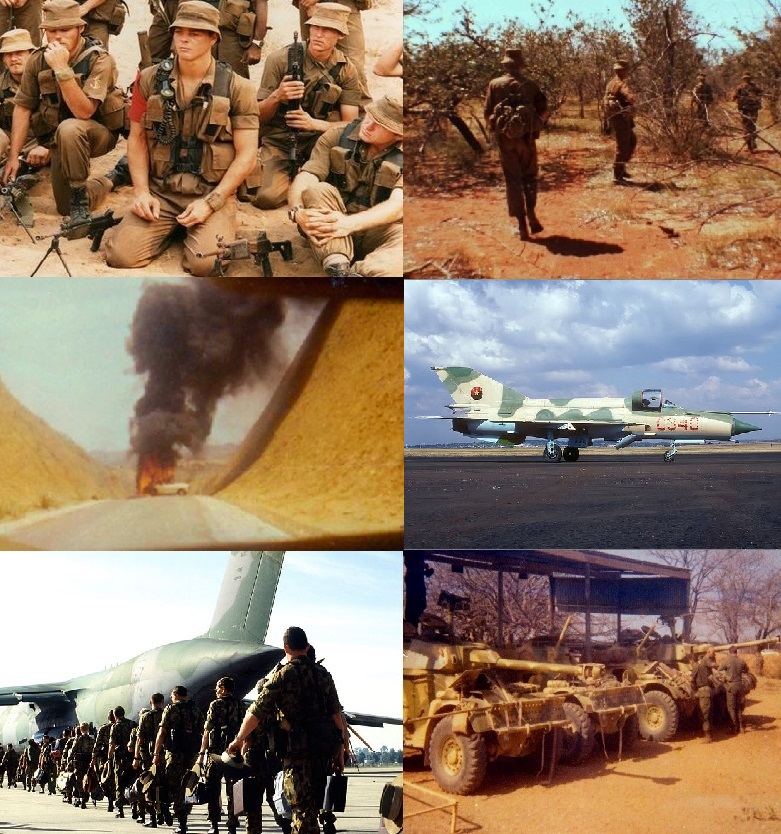
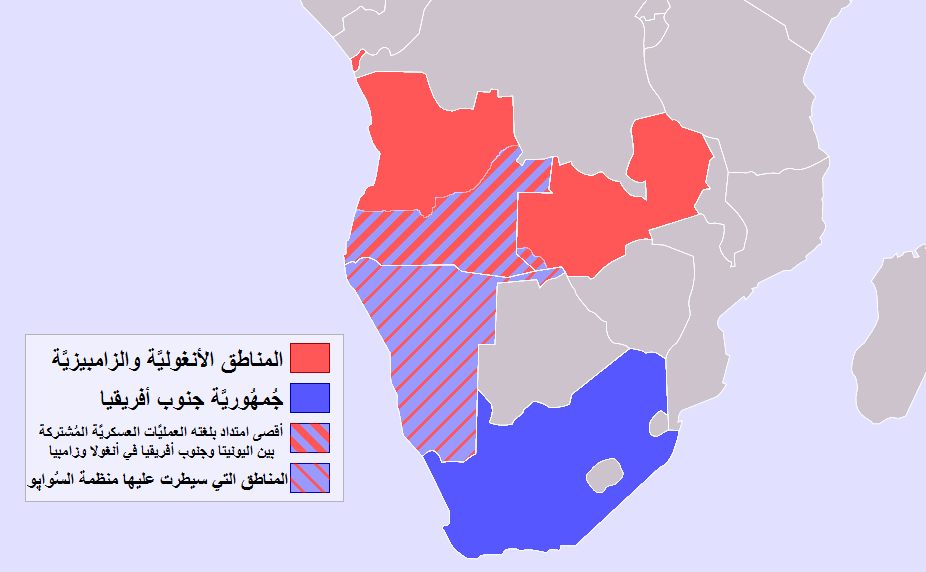
It was fought between the South African Defence Force (SADF) and the People's Liberation Army of Namibia (PLAN), an armed wing of the South West African People's Organisation (SWAPO). The conflict was closely intertwined with the Angolan Civil War and had a significant cultural and political impact on South African society.
- location
- Namibia (then South West Africa), Zambia, Angola
- belligerents
- South African Defence Force (SADF) vs. People's Liberation Army of Namibia (PLAN)
- associated_conflict
- Angolan Civil War
Lore & Background
Following several years of unsuccessful petitioning through the United Nations and the International Court of Justice for Namibian independence from South Africa, SWAPO formed the PLAN in 1962 with material assistance from the Soviet Union and sympathetic African states such as Tanzania, Ghana, and Algeria.
Reader's Guide
The South African Border War was virtually ended by the Tripartite Accord, mediated by the United States, which committed to a withdrawal of Cuban and South African military personnel from Angola and South West Africa, respectively. Despite being largely fought in neighbouring states, the war had a significant cultural and political impact on South African society. The country's apartheid government devoted considerable effort towards presenting the war as part of a containment programme against regional Soviet expansionism and used it to stoke public anti-communist sentiment. It remains an integral theme in contemporary South African literature at large and Afrikaans-language works in particular, having given rise to a unique genre known as grensliteratuur (directly translated 'border literature').
Did You Know?
- The South African Border War is also known as the Namibian War of Independence and the Angolan Bush War.
- PLAN was formed in 1962 with material assistance from the Soviet Union, Tanzania, Ghana, and Algeria.
- The SADF deployed specialist counter-insurgency units such as Koevoet and 32 Battalion.
- The war gave rise to a unique genre of Afrikaans literature known as grensliteratuur ('border literature').
Demographic Momentum and Economic Contradictions
Africa holds the distinction of being the world's second-largest and second-most-populated landmass, spanning roughly 30.3 million square kilometres and encompassing about one-fifth of all terrestrial surface. Its nearly 1.4 billion residents make it the continent with the youngest demographic profile; in 2012 the median age sat at just under twenty years, far below the global figure of thirty. Projections drawn from 2024 data suggest the population will surpass 3.8 billion by the end of this century, a trajectory with profound implications for resources, governance, and global economic participation. Yet this youthful energy coexists with a stark wealth gap. Per capita, Africa remains the poorest inhabited continent, and by aggregate measures it trails every other landmass except Oceania. Scholars point to a tangled web of causes—geographic constraints, climatic pressures, internal corruption, the legacy of colonial extraction, Cold War interference, and ongoing neocolonial dynamics. Paradoxically, the same continent that struggles with concentrated poverty also nurtures several of the world's fastest-growing economies, hinting that the demographic dividend, if properly harnessed, could reshape Africa's standing in the coming decades.
Geographic Positioning and Sovereign Architecture
Africa sits at the crossroads of the equator and the prime meridian, a position that gives it a unique geographic identity. To the north the Mediterranean Sea forms a natural boundary, while the Arabian plate and the Gulf of Aqaba mark the northeast edge. The Indian Ocean laps the southeastern coast and the Atlantic Ocean borders the west. Several European and Middle Eastern nations—France, Italy, Portugal, Spain, and Yemen—maintain small territorial enclaves on African soil, mostly in the form of offshore islands. Politically, the continent is a mosaic. It contains fifty-four fully recognised sovereign states, eight cities and island territories that belong to non-African nations, and two de facto independent entities with limited or no international recognition. Algeria claims the largest land area while Nigeria holds the greatest population. The African Union, headquartered in Addis Ababa, serves as the principal intergovernmental body through which these nations coordinate policy. Notably, Malta and Sicily, though geologically rooted in the African plate, are not counted among the continent's political entities, illustrating how geological and political boundaries do not always align.
Biodiversity and Climate Vulnerability
Africa harbours the greatest concentration of megafauna species on Earth, a legacy of having been the least impacted by the mass extinction events that wiped out large animals across other continents during the Pleistocene epoch. Elephants, rhinoceroses, and other iconic large mammals persist in numbers and diversity unmatched elsewhere, making the continent a living repository of evolutionary heritage. However, this biological richness is under mounting pressure. Desertification creeps across arid and semi-arid zones, deforestation strips critical habitats, water scarcity intensifies in many regions, and pollution degrades both freshwater and marine ecosystems. These challenges are not static; they are projected to deepen as global climate change accelerates. The United Nations Intergovernmental Panel on Climate Change has singled out Africa as the continent most vulnerable to the consequences of a warming world, a designation that underscores how the very environmental systems sustaining its extraordinary biodiversity are the most at risk. The intersection of rapid population growth, limited adaptive infrastructure, and escalating climatic stress creates a compounding threat that could reshape the continent's ecological landscape within a single generation.
Deep Roots: Humanity's Cradle and Layered History
Africa is widely regarded as the birthplace of the human species and the broader Hominidae family. The earliest known hominid ancestors date back roughly seven million years, and modern Homo sapiens are believed to have emerged on the continent between 350,000 and 260,000 years ago. From those origins, a vast tapestry of civilisations unfolded: Ancient Egypt, the Kingdom of Makuria, the Fatimid Caliphate, the Mali and Asante empires, the Kongo and Luba kingdoms, Bunyoro, Great Zimbabwe, Imerina, and the Zulu nation all rose, flourished, and in many cases fell. Yet political organisation was never the only mode of social life. Many African societies operated as heterarchical or entirely stateless communities, governing through consensus and kinship rather than centralised authority. The transatlantic and Indian Ocean slave trades scattered populations and created enduring diasporas, particularly in the Americas. From the late nineteenth century onward, the Second Industrial Revolution fuelled a rapid wave of European conquest that colonised nearly the entire continent, with only Ethiopia and Liberia retaining independence. After World War II, decolonisation produced the modern state system, and the Organisation of African Unity was founded in 1963 as the precursor to today's African Union.
Gallery
Frequently Asked Questions
What is the South African Border War?
It was a prolonged asymmetric conflict fought across Namibia (then South West Africa), Zambia, and Angola, pitting South Africa's military against the armed wing of the liberation movement SWAPO. It is also widely referred to as the Namibian War of Independence or, within South Africa, the Angolan Bush War.
Who were the main belligerents in the South African Border War?
The primary combatants were the South African Defence Force (SADF) on one side and the People's Liberation Army of Namibia (PLAN), SWAPO's military arm, on the other. The fighting was deeply entangled with the broader Angolan Civil War, which added further layers of regional involvement.
Why is the South African Border War significant?
It shaped South African military doctrine, conscript culture, and political discourse over twenty-four years of continuous combat, while simultaneously driving the end of apartheid-era control over South West Africa. Its legacy also influenced Cold War dynamics in southern Africa and the eventual dismantling of South Africa's regional military posture.
More in African Conflicts And Colonialism 1-17
Spotted an error? Know more?
This is a living reference — every entry is fact-audited, and reader corrections feed straight into our audit queue. Suggest an edit · See this site's audit record