Rwandan Civil War

Rr016 · CC BY-SA 4.0
- key_commanders
- Fred Rwigyema, Paul Kagame (RPF); Colonel Théoneste Bagosora, General Augustin Bizimungu (Rwandan Armed Forces)
Lore & Background
The RPF suffered a major setback when commander Fred Rwigyema was killed on the second day. Paul Kagame, who had been in the United States during the invasion, returned to take command.
Reader's Guide
The war ended later that month when the RPF captured the last territory held by the interim government, forcing the government and genocidaires into Zaire. The victorious RPF, with Paul Kagame as de facto leader, assumed control and began rebuilding infrastructure, prosecuting genocide perpetrators, and promoting reconciliation. As of 2026, Kagame and the RPF remain the dominant political force in Rwanda.
Did You Know?
- Fred Rwigyema, the RPF commander, was killed in action on the second day of the war.
Roots in Exile: The Birth of the RPF
The Rwandan Civil War did not emerge from a single spark but from decades of ethnic tension and political upheaval. The Rwandan Revolution of 1959 toppled the long-standing Tutsi monarchy and installed a Hutu-dominated republic. The consequences were devastating for the Tutsi community: over 336,000 were driven from their homeland and scattered across neighbouring nations. Among the displaced in Uganda, a political and military movement took shape. Under the leadership of Fred Rwigyema and Paul Kagame, the Rwandan Patriotic Front evolved from a refugee advocacy group into a disciplined, combat-capable force by the late 1980s. This transformation was rooted in a simple, desperate premise — that the Tutsi diaspora could no longer wait passively for justice and needed to fight for a place in Rwanda's future. The RPF's existence was, in essence, a direct product of the revolution's exclusionary politics, and its eventual invasion of Rwanda in 1990 was the culmination of more than three decades of forced exile and growing military preparation.
Four Years of Attrition: The Military Struggle
The conflict opened on 1 October 1990 with a bold RPF incursion into north-eastern Rwanda, pushing roughly 60 kilometres into the country's interior. The initial momentum was shattered almost immediately when founding leader Fred Rwigyema was killed in combat on the very second day of the invasion. The Rwandan Armed Forces, bolstered by expeditionary troops from France, regrouped and pushed the rebels back, leaving the RPF largely defeated by the close of October. Paul Kagame, who had been in the United States when the offensive launched, rushed back to assume command. Rather than pressing a losing frontal assault, he pulled his forces into the Virunga Mountains for a period of consolidation. From that base, the RPF waged a protracted insurgency that ground on through 1992 without either side securing a decisive advantage. Domestic protests eventually pressured President Juvénal Habyarimana to the negotiating table. Despite sabotage by the extremist Hutu Power faction and a renewed RPF push in early 1993, the parties ultimately signed the Arusha Accords in August of that year, formally ending the active phase of the civil war.
The Shattering: Genocide and the RPF's Final March
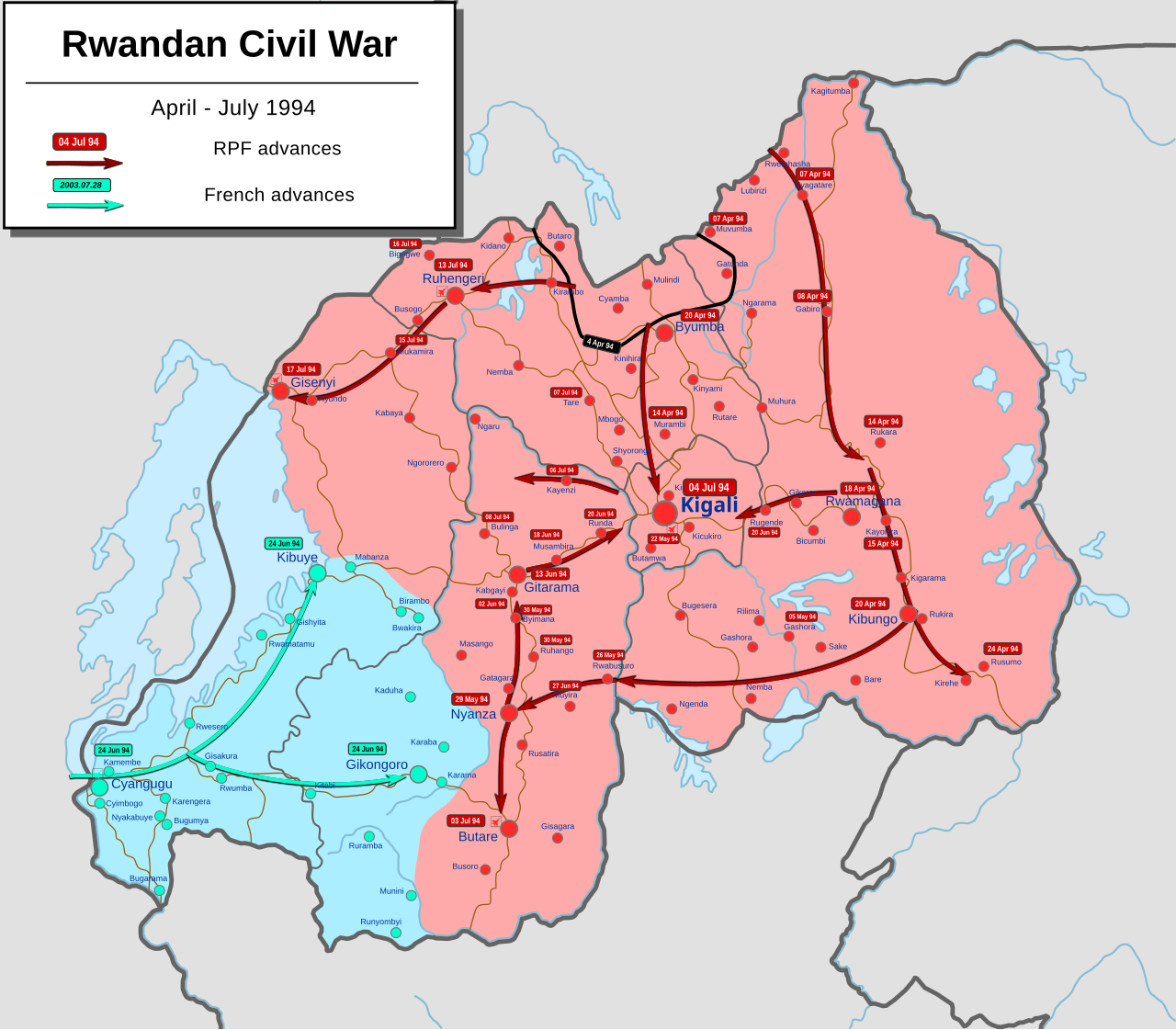
The fragile truce following the Arusha Accords was short-lived. RPF garrisons were stationed at a compound in Kigali, and the United Nations Assistance Mission for Rwanda (UNAMIR) was deployed to oversee the transition. Yet beneath the surface, the Hutu Power movement was consolidating its grip and formulating what it called a 'final solution' aimed at the total extermination of the Tutsi. That plan was triggered on 6 April 1994 by the assassination of President Habyarimana. In the roughly one hundred days that followed, between half a million and one million Tutsi and moderate Hutu were slaughtered in what is now recognised as the Rwandan genocide. The RPF, now forced back into full-scale war, advanced methodically — seizing territory, encircling towns, and severing supply lines. By mid-June 1994 the capital Kigali was ringed, and on 4 July the rebels took the city. The war closed when the RPF captured the final pockets of government-held land, driving the interim authorities and surviving genocidaires across the border into Zaire.
From Victory to Governance: The RPF's Enduring Legacy
With the civil war over, the RPF stepped into the role of Rwanda's governing power, and Paul Kagame emerged as the de facto head of state. He formally served as vice president beginning in 1994 and assumed the presidency in 2000. The new government undertook a sweeping programme of reconstruction: repairing shattered infrastructure, stabilising the economy, prosecuting genocide perpetrators through judicial processes, and fostering reconciliation between Hutu and Tutsi communities. The RPF's influence also extended beyond Rwanda's borders. In 1996, its forces launched a cross-border offensive targeting refugee camps in Zaire that housed exiled leaders of the former regime alongside millions of displaced Hutu civilians. That intervention ignited the First Congo War and ultimately toppled the long-standing dictatorship of Mobutu Sese Seko. Despite the controversies surrounding these later actions, the RPF's political dominance has proven remarkably durable. As of 2026, Kagame and his party continue to anchor Rwanda's political landscape, making the civil war's outcome the foundation of the modern state.
Gallery
Frequently Asked Questions
Who were the key commanders on each side?
Fred Rwigyema and Paul Kagame directed RPF military operations, while Colonel Théoneste Bagosora and General Augustin Bizimungu led the government's Rwandan Armed Forces. Their rival strategies defined the war's shifting front lines across Rwanda for nearly four years.
More in African Conflicts And Colonialism 1-17
Spotted an error? Know more?
This is a living reference — every entry is fact-audited, and reader corrections feed straight into our audit queue. Suggest an edit · See this site's audit record